

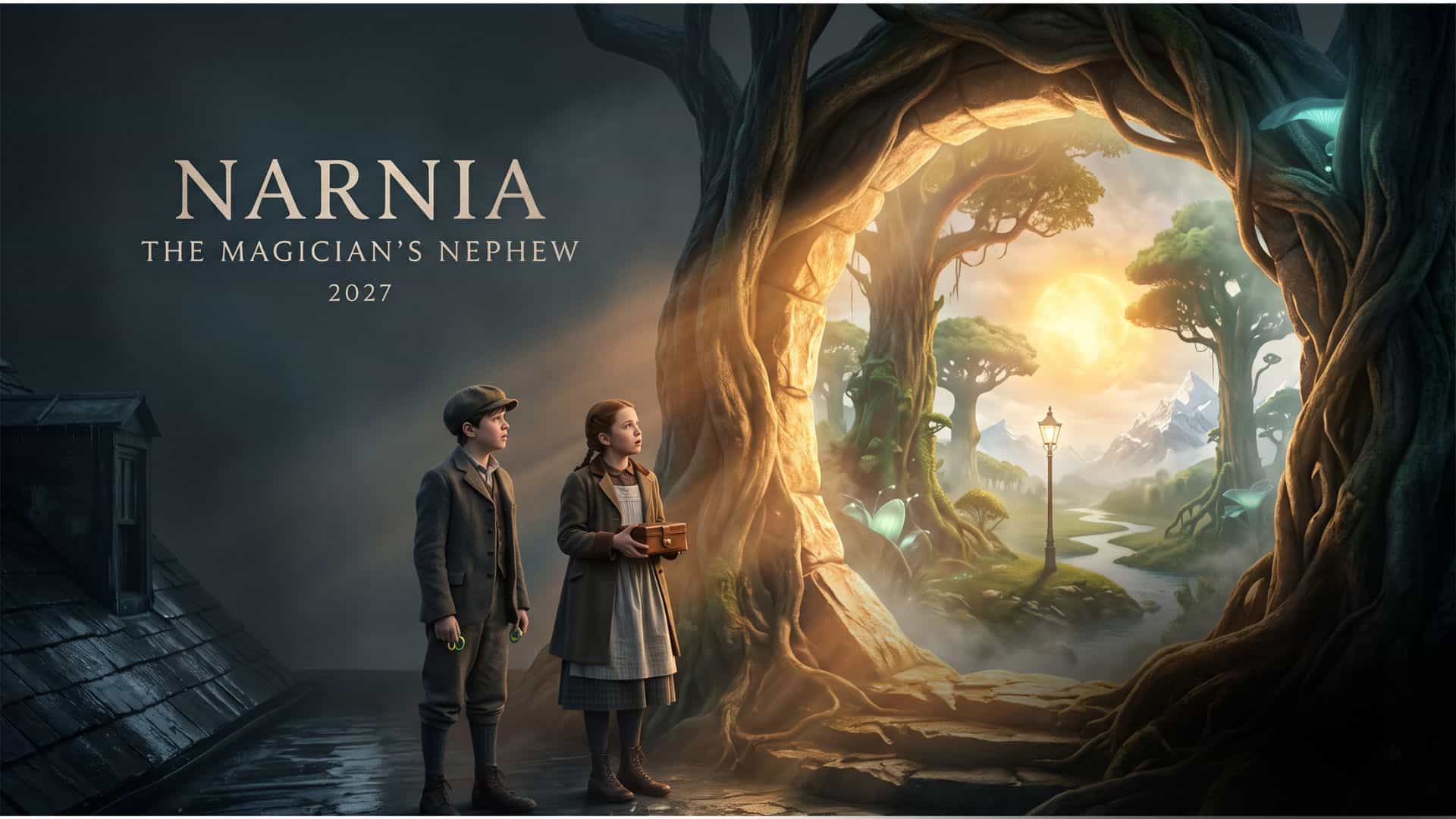
When Netflix acquired the film and television rights to C.S. Lewis’s The Chronicles of Narnia from the C.S. Lewis Company, the industry anticipated another predictable reboot of The Lion, the Witch and the Wardrobe. Instead, Academy Award-nominated filmmaker Greta Gerwig made a radical, clarifying choice: start at the true beginning.
Slated for a worldwide theatrical and IMAX debut on February 12, 2027 (with early IMAX sneak previews beginning February 10, 2027), followed by an exclusive streaming premiere on April 2, 2027, Narnia: The Magician’s Nephew marks the first time Lewis’s 1955 origin story has ever been brought to the big screen.
Backed by a reported $200 million production budget, an ensemble led by Emma Mackey, Daniel Craig, Carey Mulligan, and Meryl Streep, and a groundbreaking 54-day exclusive theatrical window co-managed by Sony Pictures, Gerwig’s film is positioned to be one of the definitive cinematic events of the late 2020s.
Production & Release Factsheet
| Category | Official Production Details |
| Official Title | Narnia: The Magician’s Nephew |
| Director & Screenwriter | Greta Gerwig (Barbie, Little Women, Lady Bird) |
| Based on the Novel by | C.S. Lewis (The Magician’s Nephew, 1955) |
| Producers | Amy Pascal, Greta Gerwig, Mark Gordon |
| Theatrical / IMAX Release | February 12, 2027 (Sneak Previews Feb 10, 2027) |
| Global Netflix Streaming Premiere | April 2, 2027 |
| Theatrical Window | 54 Days (Distributed internationally by Sony Pictures) |
| Key Cast | David McKenna, Beatrice Campbell, Emma Mackey, Daniel Craig, Carey Mulligan, Meryl Streep, Ciarán Hinds, Denise Gough |
| Original Score | Mark Ronson & Andrew Wyatt |
| Cinematographer | Seamus McGarvey, ASC, BSC (Atonement, The Avengers) |
| Production Designer | James Chinlund (The Batman, Dawn of the Planet of the Apes) |
| Costume Designer | Jacqueline Durran (Little Women, Barbie) |
| Filming Locations | Shepperton Studios (Surrey, UK) & Central London |
Why Greta Gerwig Chose The Magician’s Nephew First
For nearly seven decades, mainstream culture has treated The Lion, the Witch and the Wardrobe as the default entry point into Narnia. When Walden Media launched its 2000s film franchise with Disney and Fox, it opened with the Pevensie siblings tumbling into the snow. The Magician’s Nephew was repeatedly sidelined, drafted as an afterthought or shelved entirely.
Gerwig’s decision to open her multi-film franchise with The Magician’s Nephew shifts the entire architecture of the cinematic universe. In public statements discussing the project, Gerwig emphasized the formative impact Lewis’s prequel had on her childhood:
“I was a child when I first read The Magician’s Nephew, and I fell in love with the gorgeously improbable but completely brilliant concept of a cosmic lion singing the world of Narnia to life. I didn’t know that I would grow up to make films, but a universe built out of music is an idea that always lived in my heart. It is the honor of a lifetime to be asked to imagine it into being.”
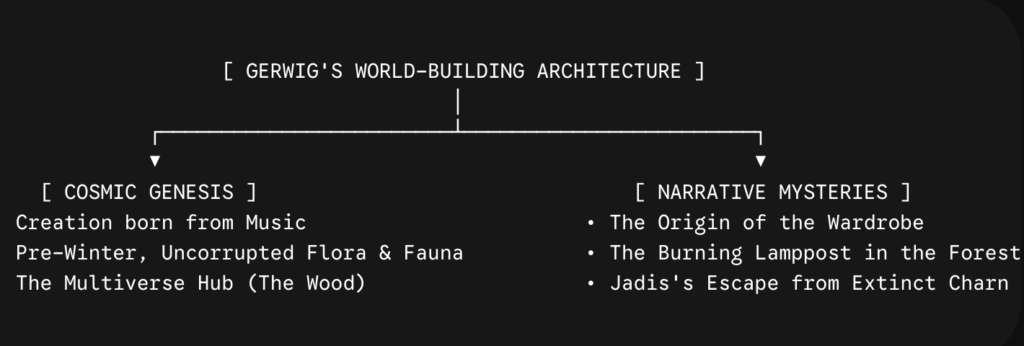
By prioritizing this story, the 2027 film resolves the long-standing lore enigmas of the series before a single Pevensie child is introduced:
- The Solitary Lamppost: Reveals why a Victorian gas streetlamp stands burning without fuel lines in a primeval forest.
- The Magic in the Wardrobe: Demonstrates that the wardrobe is made from the timber of a tree grown on Earth from an apple born in Narnian soil, creating an interdimensional link.
- The White Witch’s True Identity: Shows that Jadis is not a native creature of Narnia, but an alien sorceress-empress who annihilated her own civilization before invading a young world.
- The Human Sovereignty Rule: Explains Aslan’s decree that human beings must rule Cair Paravel, established through the coronation of Frank the London cab driver and his wife Helen.
Star-Studded Ensemble: Who Plays Who in the 2027 Film
The film brings together a mixture of breakthrough young British actors and seasoned Hollywood royalty.
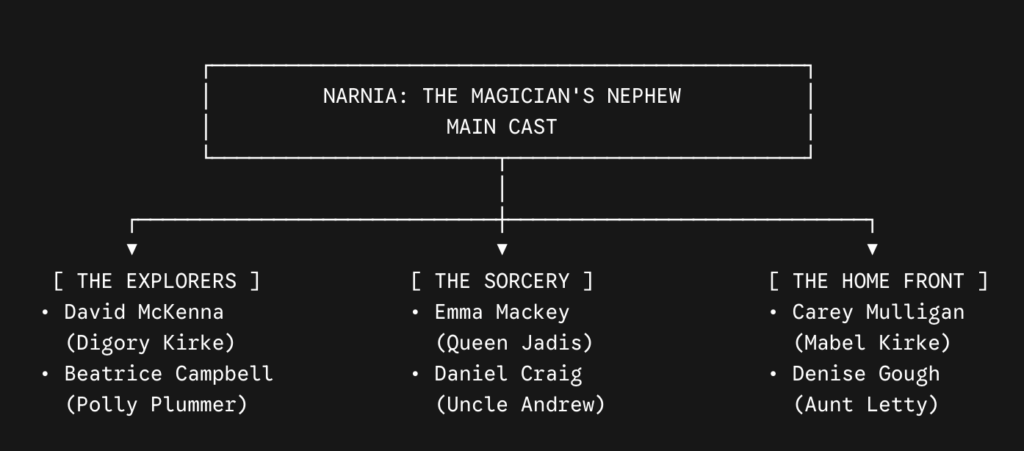
David McKenna as Digory Kirke
Following his breakout performance in the BBC/Netflix adaptation of Lord of the Flies, David McKenna steps into the role of Digory Kirke. Digory is the emotional compass of the story. Rather than a generic child adventurer, Digory is driven by vulnerability and desperation—living in exile in London while watching his mother waste away from an incurable illness. McKenna’s performance centers on moral development: moving from rash curiosity to accountability, courage, and selflessness.
Beatrice Campbell as Polly Plummer
Newcomer Beatrice Campbell (The Phoenician Scheme) plays Polly Plummer, Digory’s street-smart, observant neighbor. Polly serves as the voice of reason against Digory’s impetuosity. She is the first human traveler to set foot in the Wood between the Worlds after falling victim to Uncle Andrew’s deceit.
Emma Mackey as Queen Jadis (The White Witch)
Taking over a mantle famously held by Tilda Swinton, BAFTA winner Emma Mackey (Sex Education, Barbie, Emily) plays Queen Jadis in her terrifying prime.
Where Swinton’s performance was defined by chilling, aristocratic stillness, Mackey’s portrayal in The Magician’s Nephew captures a physically commanding, dangerous tyrant fresh off the total destruction of Charn. The film showcases Jadis as a powerhouse running amok through Victorian London, tearing up city streets before confronting the raw majesty of Aslan at the birth of Narnia.
Daniel Craig as Uncle Andrew Ketterley
In one of the film’s most anticipated casting choices, Daniel Craig portrays Uncle Andrew Ketterley. Craig steps completely away from his James Bond persona to play an eccentric, vain, and thoroughly cowardly amateur occultist. Andrew represents Lewis’s biting satire of self-important intellectuals who believe genius exempts them from common morality. Craig brings both dark humor and pathetic vulnerability to a man terrified of the magic he unleashes.
Carey Mulligan as Mabel Kirke
Academy Award nominee Carey Mulligan portrays Mabel Kirke, Digory’s bedridden mother. While her screen time is grounded in the domestic reality of Victorian London, her presence dictates the emotional stakes of the entire movie. Digory’s central dilemma—whether to steal the enchanted Apple of Life to save his mother’s life or honor his promise to Aslan—hinges on Mulligan’s grounded, heartbreaking performance.
Meryl Streep and Ciarán Hinds
Screen icon Meryl Streep joins the production in an authoritative role that has generated immense industry buzz, with trade reports and production leaks linking her to the voice of Aslan or a central cosmic narrative presence. She is joined by Oscar nominee Ciarán Hinds (Belfast, Game of Thrones) in a commanding supporting role, alongside Denise Gough as Aunt Letty, Susan Wokoma, and Kobna Holdbrook-Smith.
Detailed Cinematic Narrative Breakdown
The screenplay, written directly by Gerwig, structures Lewis’s book into a four-act cinematic journey that moves from atmospheric period drama to cosmic fantasy.
Act I: The Attic Secret and the Yellow Rings
The film opens in late-19th-century London, under overcast skies and continuous rain. Digory Kirke, grieving his mother’s impending death, meets Polly Plummer in the shared rafters of their terraced rowhouses.
Their discovery of Uncle Andrew’s locked study reveals the Atlantean rings:
- The Yellow Rings: Act as a dimensional conduit, tearing matter out of this world and pulling it into a neutral space.
- The Green Rings: Serve as a homing beacon, returning travelers to a specific planetary reality.
Uncle Andrew tricks Polly into touching a yellow ring, causing her to vanish into thin air, and manipulates Digory into following her with a pair of green rings.
Act II: The Wood Between the Worlds and the Ruin of Charn
Digory emerges in The Wood between the Worlds—a silent, tranquil nexus filled with leafy trees and dozens of glass-like pools leading to separate universes. This liminal space, shot with naturalistic lighting and quiet sound design, stands as the gateway to the multiverse.
Venturing into an unknown pool, the children discover Charn, a massive, silent metropolis rotting under a bloated, blood-red sun. Inside the Hall of Images, surrounded by statues of past monarchs, Digory’s pride gets the better of him. He strikes a golden bell, breaking the stasis spell that binds Queen Jadis.
Jadis reveals how she ended a planetary civil war by speaking the Deplorable Word—a catastrophic spell that annihilated every living organism on Charn except herself. Realizing her malice, the children attempt to flee back to the Wood, but Jadis seizes them, riding their magic back into Victorian London.
Act III: Mayhem in London and the Void of Creation
In London, Jadis causes absolute chaos:
- She treats Uncle Andrew as a submissive thrall.
- She steals a horse-drawn hansom cab, careening through the streets and causing an urban riot.
- She rips an iron crossbar off a street lamppost to use as a club.
As the police and a gentle London cabby named Frank close in, Polly and Digory link hands with the rings to pull Jadis out of Earth. In the scramble, they inadvertently drag Uncle Andrew, Frank the cabby, and his cab-horse Strawberry along with them.
Instead of landing in the Wood, they fall into an unformed, pitch-black void. Out of the darkness, a single musical note sounds. Aslan steps forward, his deep, symphonic song organizing chaos into order:
- The Stars and Skies: The void fills with harmonic celestial bodies that join in the chorus.
- The Terrain and Flora: Rolling green hills, rivers, and forests sprout in seconds from the dark soil.
- The Beasts and Speech: Pairs of animals burst from the earth, and Aslan touches them to grant the gift of reason and speech.
When Jadis hurls her iron lamppost bar at Aslan’s head, it strikes him harmlessly, falls into the fertile earth, and sprouts into a glowing, living lamppost. Terrified by Aslan’s power, Jadis flees into the wilderness.
Act IV: The Flight to the Western Garden and the Golden Apple
Knowing that evil has been introduced to Narnia on its first day, Aslan asks Digory to make amends. He transforms Strawberry the horse into Fledge, a magnificent winged steed, sending Digory and Polly over rugged mountain peaks to a walled, mountaintop sanctuary in the Western Wilds.
Inside the garden, Digory plucks a silver apple meant to grow a protective tree for Narnia. There, he is ambushed by Jadis, who has already eaten of the fruit. She tempts him:
- Take the apple back to London to cure his mother immediately.
- Eat it himself to gain immortality and conquer worlds at her side.
Overcoming his grief, Digory honors his word to Aslan, rejects the Witch’s offer, and flies back to the Lion. Digory plants the apple, growing a magnificent tree of protection. Aslan rewards Digory’s faithfulness by giving him an apple from the new tree, allowing him to return home and cure his mother.
Crafting the Cosmos: Visuals, Music, and Practical Effects
The technical team assembled for Narnia: The Magician’s Nephew emphasizes physical sets and organic filmmaking over sterile, green-screen virtual stages.
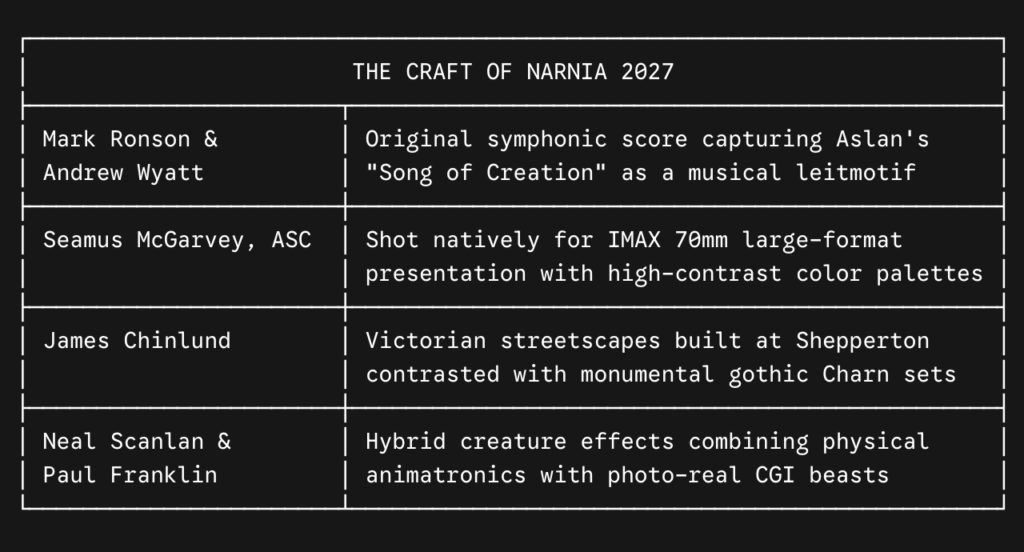
- The Musical Genesis: Mark Ronson and Andrew Wyatt, who previously collaborated with Gerwig on Barbie, were tasked with composing Aslan’s Creation Song. Because the narrative demands that the music literally generates physical landscapes and living creatures, the orchestral score acts as a primary character on screen.
- Cinematography & Lighting: Cinematographer Seamus McGarvey utilized distinct visual styles for each universe: the cool, soot-stained blues of Victorian London, the heavy crimson and dead ochre of Charn, the diffuse green glow of the Wood between the Worlds, and the rich, blooming golden hour of infant Narnia.
- Practical Animatronics: Creature effects supervisor Neal Scanlan (Star Wars) utilized complex, on-set animatronic puppets for the newly awakened talking beasts, ensuring young actors had real physical eyes to engage with before visual effects supervisor Paul Franklin (Inception, Interstellar) applied digital refinement.
The Historic Theatrical Model: Netflix Meets IMAX and Sony
The commercial release strategy of Narnia: The Magician’s Nephew represents an unprecedented pivot in how streaming giants handle high-budget tentpoles.
Historically, Netflix has limited its theatrical runs to brief two-week windows across independent theater chains to satisfy award eligibility rules. For The Magician’s Nephew, the company restructured its distribution philosophy:
- The 54-Day Exclusive Window: The film will remain exclusively in movie theaters worldwide for nearly eight weeks before becoming available on Netflix.
- Sony Pictures Global Partnership: Sony Pictures is managing the traditional theatrical distribution across thousands of commercial cinemas internationally, reporting box office grosses alongside major studio releases.
- IMAX Priority: An exclusive partnership guarantees the film premium large-format screen space across the lucrative Valentine’s Day and Presidents’ Day box office corridor.
This distribution strategy ensures that Gerwig’s massive visual canvas receives the theatrical immersion it requires while retaining its ultimate value as a subscription driver for Netflix’s home audience.
How the 2027 Movie Anchors the Upcoming Franchise
Narnia: The Magician’s Nephew is designed as the cornerstone of an interconnected, multi-film fantasy franchise.
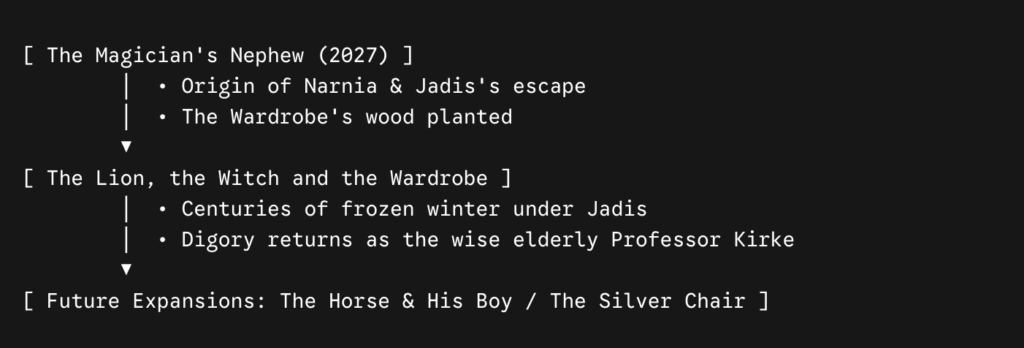
Gerwig is signed on to direct at least two Narnia feature films. By grounding the franchise in The Magician’s Nephew, subsequent adaptations will benefit from established lore:
- When the Pevensie children find Professor Kirke’s estate in The Lion, the Witch and the Wardrobe, audiences will already understand why the elderly professor immediately believes Lucy’s claims about a magical world inside the furniture.
- The White Witch’s tyrannical winter reign in Narnia will feel like the direct continuation of her ancient rampage on Charn.
- The foundational laws of Narnian magic—from the Deep Magic to the Stone Table—will have clear, consistent visual and thematic rules established right from the very dawn of creation.
Frequently Asked Questions (FAQ)
What is the exact release date for Narnia: The Magician’s Nephew?
Narnia: The Magician’s Nephew opens in theaters and IMAX on February 12, 2027 (with early IMAX sneaks starting February 10, 2027). It will debut globally on Netflix on April 2, 2027.
Who is directing the 2027 Narnia movie?
The movie is directed and written for the screen by Academy Award nominee Greta Gerwig (Barbie, Little Women).
Who is in the cast of the 2027 film?
The cast includes David McKenna (Digory Kirke), Beatrice Campbell (Polly Plummer), Emma Mackey (Queen Jadis / The White Witch), Daniel Craig (Uncle Andrew), Carey Mulligan (Mabel Kirke), Meryl Streep, Ciarán Hinds, and Denise Gough.
Is this movie a remake of the 2005 Disney film?
No. The 2005 film adapted The Lion, the Witch and the Wardrobe. The 2027 movie adapts C.S. Lewis’s prequel novel, The Magician’s Nephew, which details the creation of Narnia and has never been adapted as a theatrical film before.
How long will Narnia be in theaters before streaming on Netflix?
The movie has a 54-day exclusive theatrical window, meaning it will be shown only in cinemas for nearly two full months before arriving on the Netflix streaming service.
