

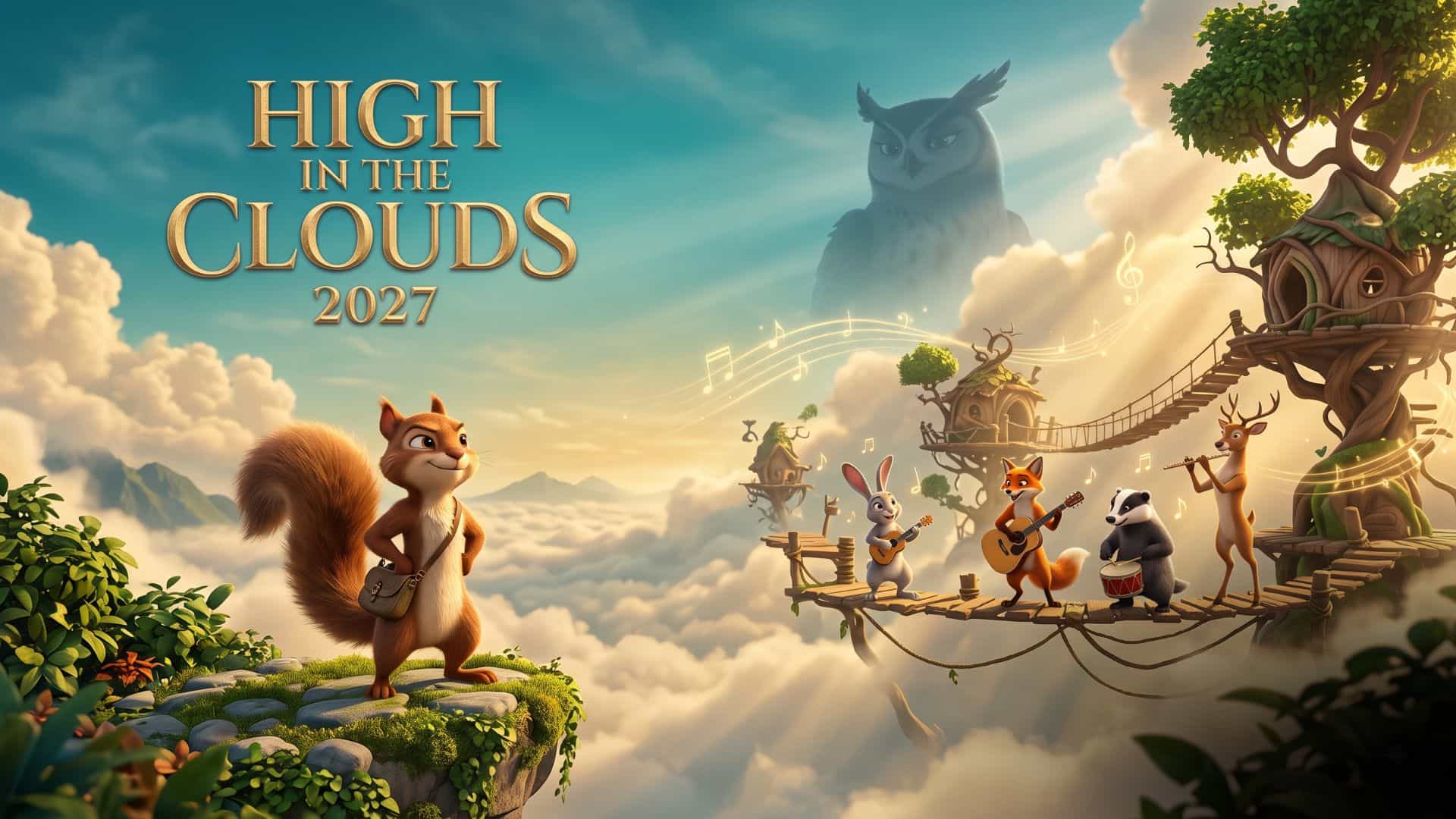
For more than two decades, Paul McCartney harbored an ambitious cinematic dream: to translate his environmental children’s fable into a full-scale animated musical feature. Born out of McCartney’s lifelong love for classic hand-drawn animation, animal welfare advocacy, and the power of songwriting, High in the Clouds stands as one of the most creatively distinct animated features in modern production.
Adapted from the 2005 illustrated book co-authored by McCartney, veteran animator Geoff Dunbar, and children’s author Philip Ardagh, the film is a vibrant blend of European storybook artistry, heartfelt environmentalism, and a brand-new original songbook written by the legendary Beatle himself.
From its long development journey across major animation studios to its narrative balance of anti-authoritarian rebellion and musical joy, High in the Clouds offers an inspiring, melody-driven adventure for audiences of all ages.
Production & Film Factsheet
| Category | Production Detail |
| Movie Title | High in the Clouds |
| Based on the Book by | Paul McCartney, Geoff Dunbar, and Philip Ardagh (2005) |
| Director | Toby Genkel (The Amazing Maurice, Ooops! Noah is Gone…) |
| Screenwriter | Jon Croker (Paddington 2, The Boy, the Mole, the Fox and the Horse) |
| Original Songs & Score | Paul McCartney (Original compositions, lyrics, and arrangements) |
| Production Studios | Gaumont Animation, MPL Communications, Unique Features |
| Producers | Paul McCartney, Bob Shaye, Michael Lynne, Sidonie Dumas, Christophe Riandee, Nicolas Atlan, Terry Kalagian |
| Animation Medium | Stylized 3D CGI Animation with 2D Storybook Texturing |
| Lead Characters | Wirral (Squirrel), Froggo (Frog), Wilhamina (Bird/Rodent ally), Gretsch (The Megalomaniac Owl) |
| Core Themes | Environmental protection, artistic freedom, anti-totalitarianism, the power of music |
From Bedtime Story to Big Screen: The Long Creative Genesis
Paul McCartney’s fascination with animation is not a recent hobby; it is a creative tradition spanning nearly half a century. Following the success of the 1984 animated short Rupert and the Frog Song (which featured McCartney’s hit single “We All Stand Together”) and subsequent shorts like Tuesdays (1991) and Dustbin Baby, McCartney recognized animation as the ideal visual canvas for his musical storytelling.
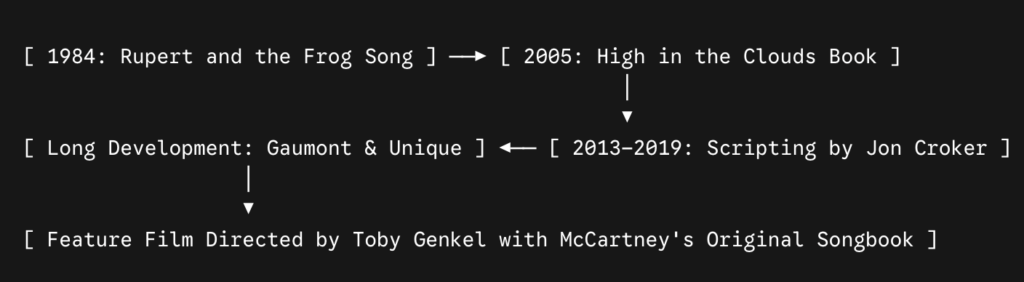
In 2005, McCartney teamed up with animator Geoff Dunbar and author Philip Ardagh to publish High in the Clouds. The book told the story of Wirral, an orphaned squirrel fighting to save his friends from industrial annihilation. The book became an international bestseller, praised for its whimsical warmth and sharp ecological conscience.
Bringing the property to the screen required an extensive creative evolution. Initial plans began with independent producer Bob Shaye (The Lord of the Rings trilogy) at Unique Features alongside French studio Gaumont. The production gained massive momentum when Jon Croker—the celebrated screenwriter behind the BAFTA-winning Paddington 2 and the Oscar-winning animated short The Boy, the Mole, the Fox and the Horse—was brought on board to flesh out the characters and modernize the screenplay.
Under the direction of European animation veteran Toby Genkel, the production embraced a hybrid aesthetic: combining cutting-edge 3D computer graphics with the tactile, hand-painted warmth of European storybooks.
Plot & Narrative Arc: The Quest for Animalia
The film reimagines the classic hero’s journey through an imaginative fable about sound, solidarity, and sanctuary.
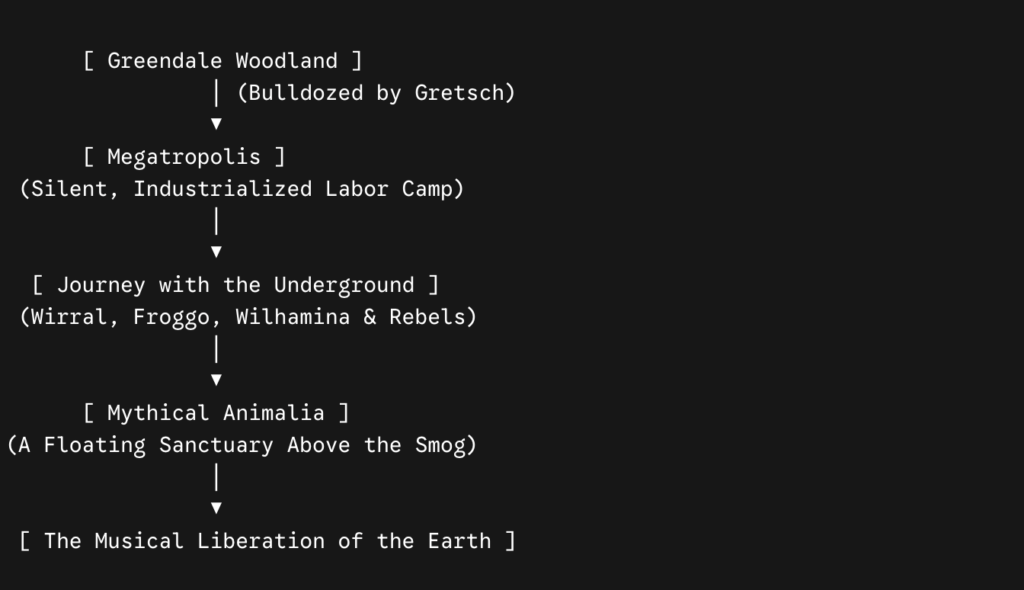
Act I: The Fall of Greendale
The story begins in the lush, sunlit valley of Greendale, a hidden woodland paradise where animals live in natural harmony. Wirral, an imaginative young squirrel with a boundless sense of melody, lives peacefully with his mother.
Their tranquil life is shattered when industrial mega-machines, commissioned by the vain and autocratic owl Madame Gretsch, tear through the forest. Greendale is flattened in hours, transformed into an extraction site to fuel Gretsch’s sprawling urban empire. In the chaos of the destruction, Wirral is separated from his home and suffers the devastating loss of his mother. Before they are parted, she tells him of an ancient legend: Animalia, a mythical sanctuary floating high above the clouds where all species live in safety, harmony, and song.
Act II: The Horrors of Megatropolis
Left alone in the world, Wirral navigates his way toward Megatropolis, a monolithic, soot-stained industrial metropolis governed by Gretsch. In this dystopian city:
- Nature is strictly outlawed.
- Animals are forced into uniform servitude, working on assembly lines.
- Music, singing, and unapproved artistic expression are banned by royal decree.
Gretsch, obsessed with her own manufactured image and absolute control, cannot tolerate music because it inspires unpredictable emotion and unity among the populace.
While hiding in the shadows of the city, Wirral meets a ragtag group of underground misfits:
- Froggo: A resourceful, cynical hot-air balloonist frog with a heart of gold.
- Wilhamina: A bold, fiercely independent young rebel who refuses to surrender her identity to the industrial machine.
- Rats & Rodents: A clandestine band of street musicians keeping rhythm alive in the city’s hidden drainage tunnels.
Act III: The Ascent to the Skies
Armed with a makeshift hot-air balloon crafted from scrap materials and fueled by determination, Wirral and his companions embark on a perilous voyage upward through the toxic smog layer choking the planet.
Surviving aerial storms and Gretsch’s sky-patrol hunters, the group breaks through the gray ceiling of industrial clouds into blinding sunlight, discovering Animalia.
Animalia is a floating ecological wonder—an archipelago of cloud-islands where rescued creatures thrive, vibrant flora flourishes without roots, and music forms the foundation of daily communication.
Act IV: The Symphony of Liberation
Wirral realizes that finding personal sanctuary is not enough. Millions of innocent creatures remain enslaved in the soot below.
Returning to Megatropolis, Wirral and his rebel orchestra use the power of unsuppressed, infectious music to awaken the downtrodden workers. When the animals find their collective voice, their synchronized rhythm overpowers Gretsch’s machines, breaks the factory walls, and dismantles her tyrannical regime from within—restoring green life to the soil and reuniting the world under a clear sky.
Character Breakdown & Thematic Roles
| Character | Species / Persona | Narrative Arc & Significance |
| Wirral | Young Squirrel | The hopeful protagonist. Traumatized by displacement and grief, he transforms his pain into creative expression, discovering that music can unite fractured communities. |
| Madame Gretsch | Megalomaniac Owl | The authoritarian antagonist. Vain, opera-obsessed yet rhythm-deaf, she represents unchecked industrial greed and the censorship of natural creativity. |
| Froggo | Aeronaut Frog | The comedic, streetwise mechanic. Initially driven by self-preservation, he learns to risk everything for a cause greater than himself. |
| Wilhamina | Fierce Ally / Rebel | The rebellious co-pilot. Sharp, defiant, and tactically brilliant, she acts as the tactical brain behind the escape to the skies. |
| The Mother Squirrel | Guiding Light | Wirral’s mother, whose opening sacrifice and bedtime stories of Animalia serve as the emotional North Star for the entire quest. |
Paul McCartney’s Musical Architecture
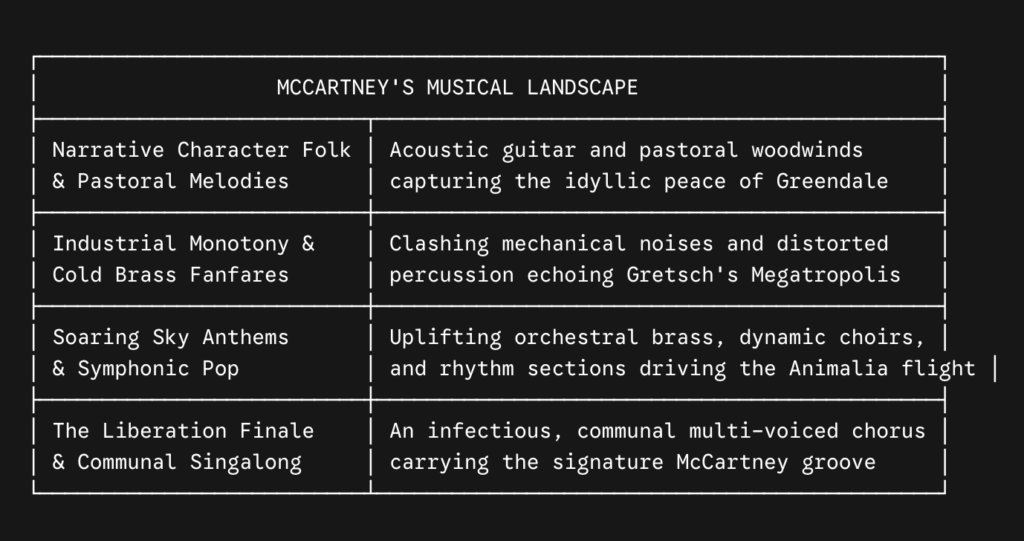
The definitive creative engine of High in the Clouds is its original soundtrack. Rather than simply licensing existing tracks or contributing a single credits song, Paul McCartney wrote a complete suite of 7 to 8 original songs conceived specifically for the narrative beats of the film.
1. Story-Driven Songwriting
Every musical number serves an active narrative purpose:
- The Pastoral Themes: Evoke traditional British folk melodies with acoustic guitars, gentle woodwinds, and organic percussion, establishing Wirral’s childhood connection to the earth.
- The Industrial March: Characterized by cold, metallic rhythms, rigid time signatures, and operatic discordance that reflects Gretsch’s mechanical oppression.
- The Animalia Flight Suite: Soaring, melodic pop-orchestral pieces reminiscent of classic Beatles arrangements, complete with lush brass sections, soaring strings, and vocal harmonies.
2. High-Profile Studio Collaborations
Over the course of the film’s music production, McCartney worked alongside top-tier producers and arrangers in historic recording facilities, including Abbey Road Studios. The soundtrack integrates McCartney’s melodic sensibilities with modern cinematic orchestration, ensuring the songs resonate with both children experiencing their first musical and lifelong music enthusiasts.
Core Themes: Environmentalism, Art, and Liberation
While High in the Clouds is paced as a thrilling animated adventure, the film explores several profound, socially relevant themes.
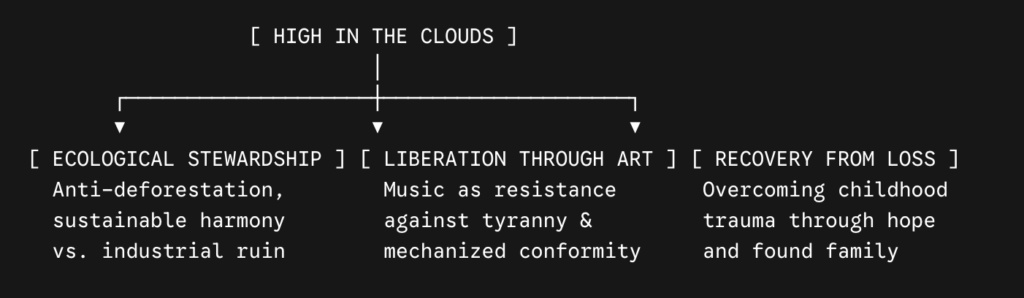
1. Ecological Consciousness and Conservation
McCartney has been a prominent animal rights and environmental activist for over half a century. In High in the Clouds, the destruction of Greendale serves as a stark allegory for real-world deforestation, habitat loss, and industrial encroachment.
The movie does not shy away from the ecological consequences of human-like greed, showing how the disruption of natural ecosystems harms every living creature.
2. The Anti-Totalitarian Power of the Arts
In Megatropolis, the first thing Madame Gretsch bans is music. Why? Because artistic expression fosters individuality, empathy, and collective joy—the very qualities that threaten authoritarian rule.
The film champions the idea that rhythm and melody are fundamental human (and animal) rights. Music becomes the literal weapon of revolution; the animals do not defeat Gretsch with violence, but by harmonizing together and shattering her silence.
3. Grief, Displacement, and Chosen Family
At its emotional center, the film is about an orphaned refugee finding a new home. Wirral’s grief over losing his mother and his home is portrayed with honesty and empathy.
Through his bond with Froggo, Wilhamina, and the Animalia community, Wirral discovers that while he cannot undo the past, he can build a hopeful future surrounded by a chosen family dedicated to protecting one another.
Visual Direction: The European Storybook Meets Modern CGI
Under the guidance of director Toby Genkel and production designer teams at Gaumont, the film’s visual style intentionally diverges from standard hyper-realistic CGI animation.
- Textured Surfaces: Characters and environments feature painted, tactile textures reminiscent of traditional watercolor children’s book illustrations.
- Color Scripting as Emotion: The film’s palette shifts dynamically:
- Greendale: Rich emerald greens, warm amber sunlight, and soft pastels.
- Megatropolis: Ashen grays, soot blacks, neon sickly greens, and sharp angular architecture.
- Animalia: Luminous cloud-whites, iridescent sky-blues, and vivid golden hues.
- Scale and Kinetic Movement: The flight sequences utilize wide-angle panoramic framing, maximizing the sense of vertical scale as the tiny hot-air balloon ascends through massive thunderheads into the celestial paradise above.
Book vs. Film: Key Creative Evolutions
While remaining faithful to the spirit of the 2005 book, screenwriter Jon Croker and the creative team expanded the narrative to support a feature-length cinematic experience:
| Feature | 2005 Children’s Book | Animated Feature Film Adaptation |
| Narrative Scope | Short, episodic fable focused on a direct quest. | Multi-layered 4-act structure with deepened world-building and character backstory. |
| Villain Profile | Gretsch is a cruel, single-note antagonist. | Gretsch is expanded into a fully realized autocratic diva with satirical vanity. |
| Musical Integration | Implied songs and poetic verses on the page. | Fully orchestrated musical numbers that actively drive plot points and action scenes. |
| Supporting Cast | Minor side characters with brief appearances. | Froggo and Wilhamina are elevated into co-protagonists with distinct personal stakes. |
| Urban Environment | Brief depiction of industrial factories. | Expansive, dystopian Megatropolis with rich visual design and subterranean rebel networks. |
Frequently Asked Questions (FAQ)
What is High in the Clouds about?
High in the Clouds tells the story of Wirral, a young squirrel who embarks on a dangerous journey to find the mythical floating sanctuary of Animalia after his woodland home is destroyed by an authoritarian owl named Madame Gretsch, who has banned music and nature.
Who wrote the original book High in the Clouds?
The original 2005 children’s book was written by Paul McCartney, animator Geoff Dunbar, and author Philip Ardagh.
Did Paul McCartney write original songs for the movie?
Yes. Paul McCartney composed a full suite of original songs and worked directly on the musical arrangements and score for the feature film.
Who is directing the animated film?
The film is directed by Toby Genkel (The Amazing Maurice), with a screenplay penned by Jon Croker (Paddington 2, The Boy, the Mole, the Fox and the Horse).
What animation studio is producing High in the Clouds?
The film is produced by Gaumont Animation in collaboration with Paul McCartney’s MPL Communications and Unique Features.
